
'The market should maintain optimism on the back of range-bound oil prices, a robust fiscal balance sheet, a better-than-expected monsoon, and moderating inflation.'

If a 5% to 10% fall in the equity market gives you sleepless nights, you are not cut out for a 75% to 80% allocation to equities and must reduce it.

Reserve Bank Governor Shaktikanta Das on Friday said 67 per cent of the decline in the foreign exchange reserves since April was due to valuation changes arising from strengthening US dollar and higher American bond yields. The forex reserves, which stood at $606.475 billion as on April 2, have declined to $537.5 billion as on September 23. It was also the eighth straight week when the reserves declined.

Following a strong performance in the 2022-23 January-March quarter, publicly listed paint industry giants displayed a mixed performance in the 2023-24 (FY24) April-June quarter. While Berger Paints India outperformed its peers and reported results in line with expectations, market leader Asian Paints and Kansai Nerolac Paints fell slightly short of expectations.

Housing sales rose 7 per cent annually in 2024 across eight major cities to reach 12-year high at 3,50,613 units on better demand for premium homes amid stable mortgage rates and strong economic growth, according to Knight Frank. Last month, real estate consultant Anarock, however, had reported that housing sales declined 4 per cent in 2024 to nearly 4.6 lakh units across seven major cities.

After a strong run in the midcap and smallcap indices, which surged 46 per cent and 43 per cent, respectively, on the National Stock Exchange (NSE) during Samvat 2080, analysts suggest that the rally in these segments may pause to catch its breath in Samvat 2081.
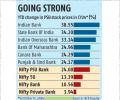
Stock Market News today, PSU banks: The year 2024 was a roller-coaster ride for Indian stock markets, marked by volatility driven by the Lok Sabha elections, Union Budget 2024, a slowdown in corporate earnings, and sticky inflation. Geopolitical tensions - particularly between Israel and Iran in West Asia - along with various stimulus announcements by China and yen carry trade rocked the equity markets throughout the year.

'Indian equity valuations, although not very expensive, are not cheap either.'

Indian equity markets have a limited upside potential in the near-term as they negotiate the ensuing cyclical slowdown, wrote analysts at Nomura in a recent coauthored report led by Saion Mukherjee, their managing director and head of equity research for India. He, however, believes that the foundations are in place for sustainable growth over the medium-to-long term, and hence suggests a 'buy on dips' strategy to equity investors. As an investment strategy, Nomura prefers domestic-oriented sectors and companies over exporters, and prefers stocks that provide valuation comfort. Industrials and banks are their overweight sectors, while IT services and consumer discretionary are their underweight sectors.

Investors attribute the revival to the country's strong public markets, which are boosting confidence in initial public offering (IPO)-bound startups offering viable exit opportunities.
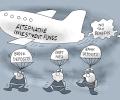
Around Rs 1 trillion, or a fifth of the investments made by alternative investment funds (AIFs) are questionable in terms of the intent behind the investments and are under the scanner for circumvention of regulations, said Ananth Narayan, whole-time member of Securities and Exchange Board of India (Sebi). AIFs are pooled investment vehicles that invest in a variety of assets including real estate, startups, unlisted companies, and derivative strategies in the listed space.
JSW Steel, owned by Sajjan Jindal, has emerged as the world's most valuable steelmaker, boasting a market capitalisation (mcap) of nearly $30.31 billion, according to Bloomberg data.

As regards mid-caps and small-caps, analysts suggest investors buy only those stocks of those companies where there is earnings visibility for at least a few quarters and where the valuations have become reasonable.

The sharp surge in investment accounts (folios) in midcap and smallcap mutual funds (MF) in recent months is likely driven by the do-it-yourself (DIY) investors. In the first five months of the present financial year (FY 2024), net folio additions in direct MF plans (4.5 million) has outpaced that in regular plans (3.9 million), contrary to the trend seen in the previous three six-month periods. The net folio additions in direct plans in the five-month period (April-August 2023) is 40 per cent higher than the total additions made in the previous six month period.

Once a quality stock has been bought, the next challenge is to hold on to it -- no mean feat in this age of information overload and incessant noise.
From the 30-share Sensex pack, Tata Consultancy Services, Infosys, NTPC, HCL Technologies, Axis Bank, Tech Mahindra, Bajaj Finserv, Sun Pharma, IndusInd Bank and Reliance Industries were the major laggards. Tata Steel, Hindustan Unilever, Mahindra & Mahindra, Nestle and State Bank of India were among the gainers.
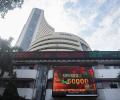
The top 10 valued firms added a total Rs 1,56,317.17 crore to their market valuation last week, helped by across the board rally which catapulted the benchmark index Sensex to the record 60,000 mark for the first time. During the last week, the 30-share BSE benchmark rallied 1,032.58 points or 1.74 per cent. The BSE Sensex made history on Friday by reaching the 60,000-mark for the first time ever. The market capitalisation (mcap) of Reliance Industries zoomed Rs 58,671.55 crore to reach Rs 15,74,052.03 crore. The m-cap of RIL went past Rs 16 lakh crore mark in intra-day trade on Thursday following a rally in its share price.

The total market valuation of the BSE-listed companies is nearing the Rs 100 lakh crore-mark following the continued dream run of the bourse.

Over the past week, the BSE benchmark index Sensex gained 474.79 points to end at 25,519.22

Hyundai Motor India (HMIL) raised Rs 8,315 crore from anchor investors on Monday, setting the stage for the country's biggest-ever maiden share sale. The Indian arm of the South Korean carmaker Hyundai Motor Company (HMC) allotted 42.4 million shares to 225 funds at Rs 1,960 apiece, the higher end of its price band. Among the investors receiving allotments were the Singapore government's sovereign wealth fund (GIC), New World Fund, and Fidelity.

India's second-largest passenger vehicles firm will be valued at Rs 1.59 trillion at the top-end of the price band of Rs 1,865-Rs 1,960.

'Consider 40% to 50% in equities, 10% in gold as a hedge, and the remaining 30% to 40% split between multi-asset funds and hybrid funds.'


Madhabi Puri Buch, the first female chairperson of Sebi, doesn't plan to rest on her laurels in her third and final year in office and has set out an ambitious goal, such as moving towards a same-day and instantaneous settlement cycle for the secondary market.

The stock of India's largest listed pure play retail major Trent was down 14.76 per cent at close on Monday after a fall in revenue growth for the March quarter of 2024-25 (Q4FY25). The sales growth trajectory has been in a declining trend over the last few quarters, which, coupled with falling operational metrics, higher competitive intensity, and expensive valuations, has seen the stock crack about 44 per cent since its 52-week highs in October last year.

Foreign investors have made a strong comeback to Indian equities with a net investment of Rs 22,766 crore in the first two weeks of December driven by expectations of rate cut by the US Federal Reserve. This revival follows significant outflows in the preceding months, with Foreign Portfolio Investors (FPIs) pulling out a net Rs 21,612 crore in November and a massive Rs 94,017 crore in October -- the worst monthly outflow on record.

From the 30 Sensex firms, Larsen & Toubro, Reliance Industries, Axis Bank, Asian Paints, Tata Motors, Bajaj Finance, Maruti, Bajaj Finserv, Kotak Mahindra Bank, Titan, Adani Ports and HDFC Bank were the major laggards. JSW Steel emerged as the only gainer.

'If their allocation to certain segments have become high due to strong returns over the past three-four years, they should rebalance their portfolios and bring them in line with their long-term asset allocation.'

HDFC Life Insurance Company (HDFC Life) delivered a strong performance in the December quarter of the current financial year (Q3FY25), exceeding market expectations with robust earnings growth. The company reported a 13.7 per cent year-on-year (Y-o-Y) increase in net profit to Rs 414.9 crore in the quarter. The value of new business (VNB) rose 8.6 per cent Y-o-Y to Rs 930 crore, compared to Rs 856 crore in the corresponding quarter of the previous year.

'In 2022, active management, long-short strategies, multi-asset strategies, and asset allocation strategies need to be considered to meet long-term investment goals.'

Automobile giant Tata Motors' shares were in demand on Wednesday as the stock rallied as much as 3.69 per cent to hit an intraday high of Rs 671.80 per share, before settling 3.18 per cent higher at Rs 668.45. By comparison, the BSE Sensex settled 0.10 per cent, or 72.56 points, lower at 74,029.76.

From the 30 Sensex firms, Mahindra & Mahindra, Infosys, Kotak Mahindra Bank, JSW Steel, Adani Ports, Tata Motors, Adani Ports, ITC and Titan were the major laggards. HDFC Bank, Bharti Airtel, Reliance Industries, Asian Paints and State Bank of India were the gainers.

Automobile, apparel and electronics are among sectors that see a sales boost during the festival season, a time when investors expect gains in related stocks. This year could be different: Analysts have factored in all positives and do not expect such stocks to deliver lucrative returns. "Indian households spend across sectors like automobiles, consumer durables, and consumer staples during the festival season.

'Focus on 19,400/64,900 as the key resistance levels for the Nifty/Sensex.'
The government is unlikely to come up with the IPO of Life Insurance Corporation (LIC) in the current financial year ending March 2022, as the valuation of the state-owned behemoth is taking more than anticipated time, and the preparatory work is still far from complete. There are still some issues that need to be addressed with regard to the valuation of LIC, a senior official of one of the merchant bankers said. Even after the valuation, there are several regulatory processes that have concluded, the official said.

The combined market capitalisation of BSE-listed companies hit an all-time high of Rs 343.48 lakh crore on Monday, amid a rally in equities after the BJP registered victory in assembly polls in three Hindi heartland states. Following the sharp uptick in the market, investors became richer by over Rs 5.81 lakh crore on Monday. The 30-share BSE Sensex jumped 1,383.93 points, or 2.05 per cent, to close at a lifetime high of 68,865.12.

IPOs inherently carry more risks than stocks that have been listed on the exchanges for some time.

All the three companies that made their stock market debut on Wednesday delivered huge day-one gains for investors. Shares of digital payment major One Mobikwik Systems surged 90 per cent, while that of fashion retailer Vishal Mega Mart and pharma firm Sai Life Sciences gained around 40 per cent each. These stellar debuts came despite the benchmark indices logging continuous declines since their initial public offerings (IPOs) closed on Friday.

A sharp sell-off in the Indian equities markets after a spike in crude oil prices should not be surprising. Historically there is a negative correlation between stock valuations in India and the price of Brent crude oil, which is the benchmark for the Indian crude oil basket. Between 2011 and 2014, crude oil traded above $100 a barrel for an extended period, the Sensex-trailing price/earnings (P/E) was 18X, on average, during the period, nearly 22 per cent lower than the current index P/E of 23X.

India's stock markets are experiencing a shift in investor sentiment, with a 30 per cent surge in Chinese stocks, prompting investors to move money from domestic markets to China. This reversal of fortunes is a notable change from the past three years, where China's losses benefited India.
